Fort Myers Pediatric Dental Services
At Fort Myers Pediatric Dentistry, we provide gentle, kid-focused dental care designed to help children feel comfortable, confident, and proud of their smiles. From routine checkups to more advanced treatment, our team is here to support your child’s oral health at every stage.

Preventative Care

Restorative Dentistry

Special Needs Children

Orthodontics

Sedation Dentistry

FAQ
Child’s First Visit
The American Academy of Pediatrics and the American Academy of Pediatric Dentistry recommend a child’s first visit be 6 months after the eruption of their first tooth, or by their first birthday. By establishing a pediatric dental home for your child early in life, our dentists will be proactive about providing guidance on oral development, healthy teeth diet, oral habits and injury prevention, and oral hygiene.
What happens at my child’s dental visit
Your child’s age and ability to reason typically dictates what preventive procedures will occur at their child’s visit. Children less than 3 years of age usually do not tolerate much more than a oral exam..maybe a toothbrush cleaning and fluoride application. Often the examination is where the child lays on the parents lap with the doctor looking at their teeth.
As children mature beyond the age of three, their ability to reason and tolerate more involved preventive procedures increases. An oral exam along with a cleaning and fluoride treatment can be expected at every checkup visit. X-rays are taken periodically and their frequency is determined by their risk factors, and their stage of development. Taking x-rays can often catch small problems that can be addressed before they develop into larger more complicated and costly dental procedures. Once the child erupts their permanent molars, we strongly recommend and complete as early as possible, protective sealant coatings for the child’s permanent molars, before tooth decay has a chance to set in. This is often done at the same visit minimizing the child’s and parents need to schedule another dental appointment.
Our pediatric dentists and staff go out of our way to make sure parents get all their questions and concerns addressed at each visit with regards to their child’s dental health. We are all parents, and we “get it”…we try to give each and every child the care and attention we would give our own children if they were getting their dental needs addresses.
Preventative Care
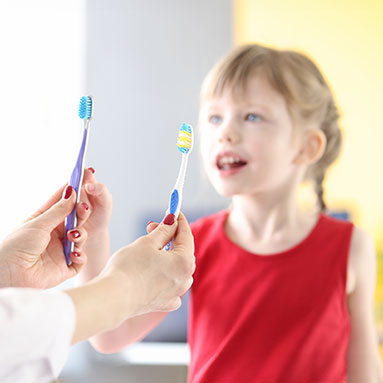
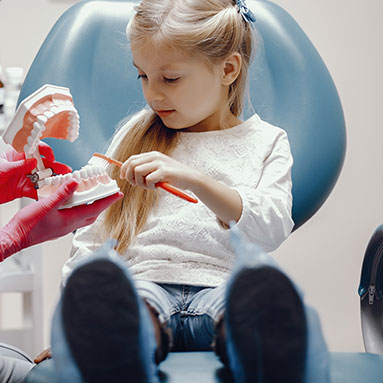
At Pediatric Dentistry of Florida, our philosophy is based around preventing dental disease from happening, and thus helping to make children’s dental visits positive, and helping them grow and develop with healthy habits, and a positive outlook and perspective to their dental health.
Restorative Dentistry
Tooth colored or “white fillings”
At Pediatric Dentistry of Florida, we use resins, or “tooth colored” fillings to restore smaller sized cavities on teeth. These fillings are made from durable types of acrylic and are commonly called composite resins. These fillings are highly esthetic and allow us to preserve a greater amount of healthy tooth structure.
Crowns
When a cavity is too large to be filled, a crown restoration is necessary. A crown is a full coverage restoration that wiull protect the tooth and last longer than a filling.
Stainless Steel Crown
Used to save teeth that otherwise would be lost. One of the strongest and most durable services in pediatric dentistry, they last longer than fillings and cost less than other types of crowns. Their biggest disadvantage is their color, a polished silver, and for this reason are used mostly on posterior (molar) teeth.
Composite Resin (Tooth colored) crown
Resin crowns are used also for teeth unrepairable with fillings. They look more natural looking and can provide a excellent cosmetic result for your child. However, they are more expensive, and may be less durable, and require more time to do than stainless steel crowns. They are generally used only on anterior (front teeth) because of their esthetics and lesser durability.
Nerve Treatments
Every tooth has a nerve and blood suppoly known as the pulp. It needs to remain healthy for your child’s tooth to be vital and pain free. Sometimes extensive tooth decay, or a traumatic injury that injured the nerve will create infection and can result in pain. A pulpotomy (partial nerve removal) will be performed to restore your child’s tooth and return it to good health. Once completed, a crown restoration is usually performed to return the tooth to complete function.
Special Needs Children
Children with special needs deserve our special attention. Starting preventative dentistry early is particularly important for a special needs child. Unlike many of the health conditions faced by patients with special needs, dental disease is preventable. A special needs child will benefit from the preventative approach recommended for all children: effective brushing, and flossing, limited snacking, adequote flouride, sealants, and regular dental visits.
As a parent of a child with special needs, you may have concerns about your child’s tolerance for a detal visit. Whatever your concerns, do not postpone preventative dentistry for your child. Our pediatric dentists understand that each child is unique and may need extra care to feel comfortable during treatment. Every child is different and because of this, our approach to treating each child will be tailored to their specific needs. Our pediatric dentists will provide a plan that is compassionate and effective.


Orthodontics
Orthodontics (braces) the science and art of straightening teeth and correcting jaw or bite discrepancies is a important part of any healthy and complete dental haleth plan.
Typically, orthodontic therapy begins after the shedding of the baby teeth, however, certain growth conditions require earlier intervention, sometimes even as early as seven or eight years old. Your child’s pediatric dentist is perfectly positioned to evaluate your child’s growth and developmental condition, and will inform you of their findings and recommendations. We have a board certified orthodontist on our team and we will recommend a evaluation when the time is right for your child.
Space Maintainers
A baby tooth usually stays in place until it is ready to be lost on its own and replaced by a permanent tooth. For some children, they may not happen until the child is as old as age 14. Sometimes though, a baby tooth is lost too soon due to injury or dental disease. If a baby tooth is lost too soon, the remaining adjacent teeth may shift or drift into the empty space. When this occurs, it creates a lack of space in the jaw for the future permanent teeth. This results in a permanent tooth that may not erupt, or if it does, will do so in a improper position. A space maintainer, also known as a spacer, if deemed necessary, will help prevent the closure of space so the permanent tooth will someday have room to erupt into place.
Sedation Dentistry
There is no getting around the fact that some dental care can be uncomfortable. Some children are not capable of tolerating dental care while others are simply not yet ready.
Our objective is to make your child as comfortable as we can while completing their dental treatment. The options we use for creating comfort include topical anesthetic cream, local anesthetics, and nitrous oxide (laughing gas), and IV sedation with a highly trained pediatric anesthesiologist. You will always have the ability to discuss these options with your pediatric dentist.


Frequently Asked Questions
When should my child first see a dentist?
What is a pediatric dentist?
When should my child visit the orthodontist?
The pediatric dental specialty places special emphasis on childrens dental development. Your child’s complete dental condition, including facial development and tooth positions, are evaluated at every routine care visit. Your pediatric dentist will inform you when your child is ready for a orthodontic evaluation. Pediatric Dentistry of Florida provides full comprehensive orthodontic care at our Fort Myers location. We will help you schedule a orthodontic evaluation when your child is ready.
Are baby teeth really that important?
What are dental sealants and how do they work?
What are dental sealants and how do they work?
Are dental x-rays necessary and are they safe?
As parents ourselves, we can understand the concern parents have about taking dental x-rays. The simple truth is, we can not properly or effectively care for your child without them. There is a miimum standard of care that must be met when providing oral health care and it involves appropriate dental x-reays at appropriate frequency specific to each patients needs. The good news is, dental x-rays today are safe, more so than ever before. We use digital x-ray technology that greatly reduces the exposure compared to traditional x-rays of the past. So much so reduced that lead aprons are always used whenever possible to even further reduce your child’s exposure.